
Finding work gloves that actually survive rope access and rigging work shouldn’t be this hard. We stock specialist technical gloves built for the job: belay gloves with proper grip, chemical-resistant options that last, and insulated PPE for work at height. All EN certified with transparent specs, reliable sizing, and bulk pricing that makes sense.


Product & Standards
EN 388 is the European standard for gloves that protect against mechanical hazards. It grades the level of protection against different risks such as abrasion or tearing. Other hazards like heat and chemicals are covered by separate standards.
Underneath the 'shield' icon on a glove you'll find a series of numbers and letters representing resistance to:
| Hazard | Rating scale |
|---|---|
| Abrasion | 1 – 4 |
| Cut (circular blade) | 1 – 5 |
| Tear | 1 – 4 |
| Puncture | 1 – 4 |
| Cut (flat blade) | A – F |
| Impact | P / F / X |
A higher number or letter indicates better protection. Impact is rated as Pass, Fail, or X (not tested).
EN 388:2016 is the newer revision and introduces additional tests, indicated with letters rather than numbers. There have also been some small changes to the way the existing tests are carried out, so ratings are not always directly comparable between the two versions.
EN 388 covers the basic mechanical risks you encounter in rope access: handling rope, contact with rough surfaces, and general abrasion.
ANSI/ISEA 105 is the US equivalent of EN 388. The two are broadly similar. If you're in the UK or Europe, EN 388 is the legal requirement for a manufacturer placing gloves on the market.
EN 420 gives a dexterity rating from 1–5. The higher the number, the easier it is to handle small objects. Dexterity is usually a trade-off against protection: thicker, more protective gloves tend to reduce dexterity, and vice versa.
Sizing & Fit
Each manufacturer provides their own sizing instructions; it usually involves measuring around your palm, between your thumb and knuckles. Check the product page or packaging for the specific brand's size chart.
Follow the manufacturer's instructions for measuring your hand. If you're able to visit a shop, trying gloves on is always the most reliable method, particularly for rope access, where fit really matters.
Gloves that are too big leave loose material that gets in the way when gripping. Excess fabric at the fingertips makes it particularly hard to operate carabiners. Gloves that are too tight restrict movement, reduce grip, and can limit blood flow, leading to cold or numb hands.
Material & Durability
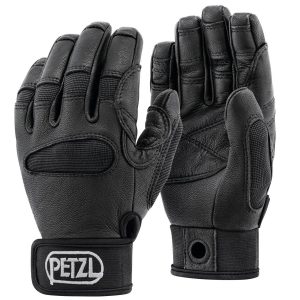
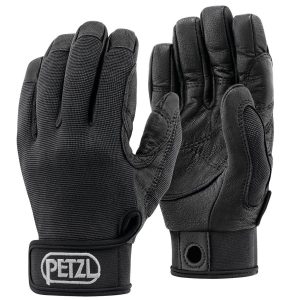
Leather is generally harder-wearing and doesn't melt with friction the way some synthetic materials can. Synthetics can offer other advantages such as lighter weight and better breathability, but for durability under rope friction, leather tends to be the better choice.
A leather (or high-quality synthetic equivalent) palm offers resistance to rope friction, while a mesh back helps with ventilation. If you're not abseiling long distances in a single continuous descent, rope friction is less of a concern and other glove types may be suitable, depending on the risks identified for the job.
Generally not. Leather absorbs water. If you need waterproof hand protection, you'll need to look at gloves specifically designed for wet conditions.
The materials and construction determine cut resistance. Some gloves use multiple layers of different materials, such as high-performance polyethylene or steel fibre, to improve their cut rating.
Usage & Maintenance
A good fit and protection against the specific risks identified for each job. There's no single "best" rope access glove; it depends on what you're doing.
Follow the manufacturer's guidance, but in general: keep them reasonably clean and regularly check for holes or tears that could expose your hands. Also look for loose threads, as these can snag on equipment, particularly carabiners.
Clean them with water and pure soap as needed. There shouldn't be any need for specific leather treatment products. Bear in mind that if you do apply anything to the gloves, some of it is likely to transfer onto your rope.
Small cuts and abrasions are by far the most common.
Specialist Applications
Some belay gloves have no fingertips for improved dexterity; other than that, the two types are very similar.
Something that fits well and protects against the risks identified for the particular task. For long abseil descents, a leather-palmed glove is usually preferred for its friction resistance.
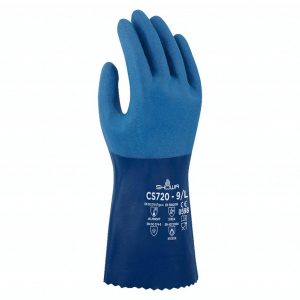
Possibly. Leather-palmed rigging gloves are unlikely to have any chemical resistance, so you'll need a chemically resistant glove first. These may also be suitable for the rope access element, but you'll have to assess that. In some cases you may need different gloves for different parts of the job: one pair for rigging, another for handling chemicals.
Copyright 2026. All Rights Reserved
